Jul 13, 2026-Reviews
goahead Review - Statistical Significance in Marketing, Made Practical
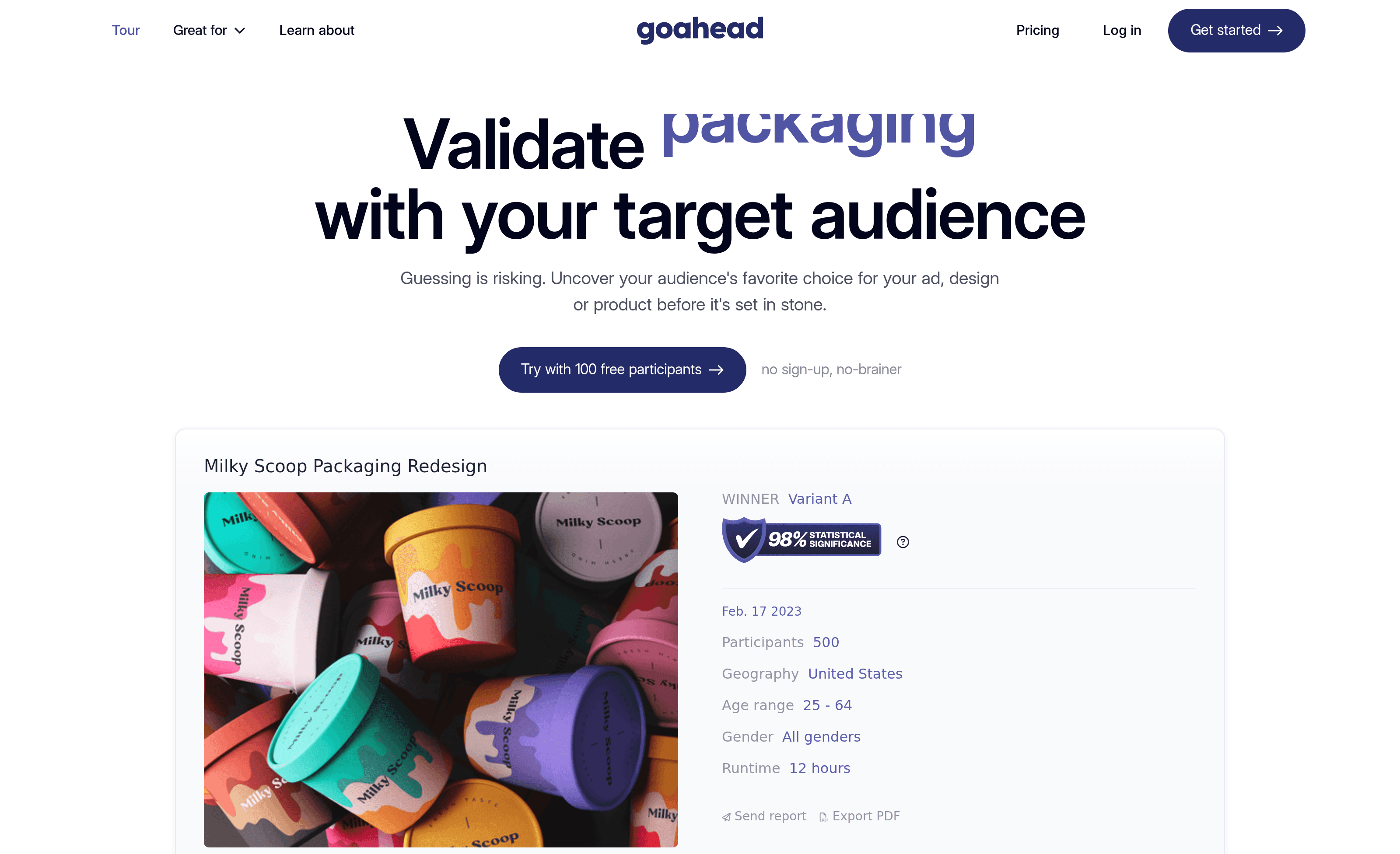
We've tested goahead, a validation platform that runs your ad, packaging or design past a targeted audience and tells you which version wins with statistical significance.
Welcome to this goahead (goahead.io) review ✨
Every creative decision eventually comes down to the same tense little moment: which logo, which cover, which ad? Most teams resolve it the same way — the loudest person in the room picks, or you poll a handful of colleagues who already know what answer you're hoping for. Neither is data. Both feel like data at 5pm on a deadline.
goahead attacks exactly that habit. It's a validation platform that takes your competing versions — an ad, a packaging design, a book cover, a product shot, a video — puts them in front of a targeted panel of real participants, and tells you which one actually won, with enough people behind the result that it isn't just noise. Its whole pitch is built on a phrase you don't usually see on a marketing site: statistical significance. That's the thing I most wanted to test, so I built a real validation survey end to end and pushed it right up to launch.
Getting started: a survey builder, not a signup wall
The first thing goahead gets right is that you can try it without an account. The "Try with 100 free participants" button drops you straight into a six-step wizard at try.goahead.io — no email, no card, no "book a demo." For a category that usually hides behind sales calls, that alone is refreshing.
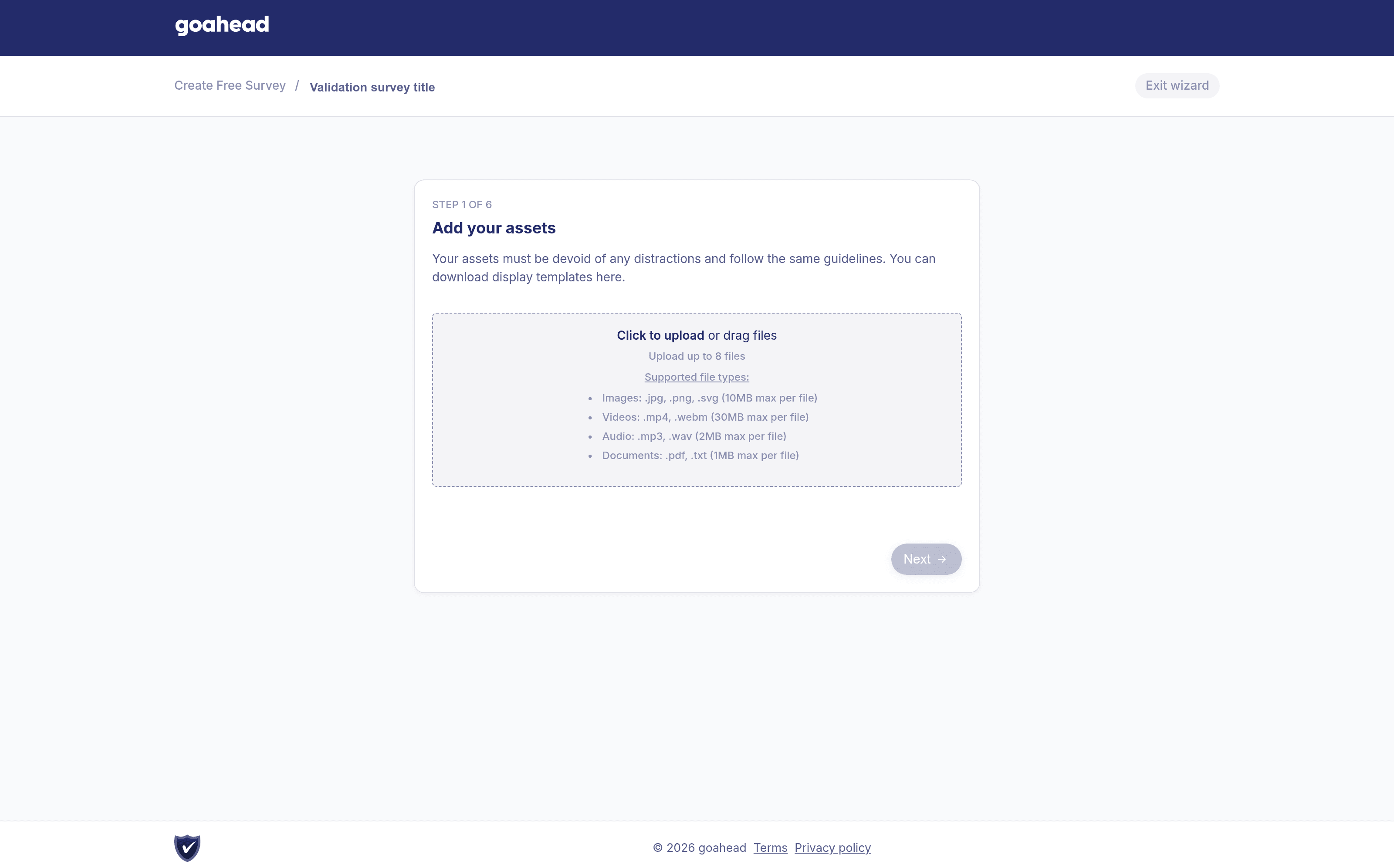
The wizard walks you through it in a logical order: add your assets, define the survey, optionally ask follow-up questions, pick your audience, invite trusted people, then review and launch. Step one is just an uploader — up to eight files, with clear limits printed on the box (images up to 10MB, video up to 30MB, audio 2MB, documents 1MB). One instruction sets the tone for the whole product: "Your assets must be devoid of any distractions and follow the same guidelines." In other words, if you want a clean read on which design wins, the designs have to differ on the thing you're testing and nothing else. That's the right discipline, and it's on you to bring it.
I uploaded two mock coffee-bag designs — a dark variant and a light one — titled the survey "Brewly coffee bag redesign," and wrote my validation question: "Which packaging design makes you more likely to buy this coffee?" Step two nudges you to introduce the brand and phrase the question well, because a vague question gets you vague data.
Audience targeting: who answers is the whole game
This is the section that separates goahead from just posting a poll in your group chat. Before you launch, you tell goahead exactly who you want to hear from, and it matches participants to that spec on its own.
In the builder you set a participant count on a slider (the free demo caps at 50; paid surveys go well beyond), an age range across brackets from 18-24 up to 64+, a gender filter, and a location. Location is nicer than I expected: start typing "Swe" and it autocompletes to SWEDEN (SE), and you can stack several countries as removable chips — I ran mine against Sweden and France together — or leave it as "World." There's also a maximum runtime setting that caps how long the survey stays open. On the full product the targeting extends to attributes like education too.
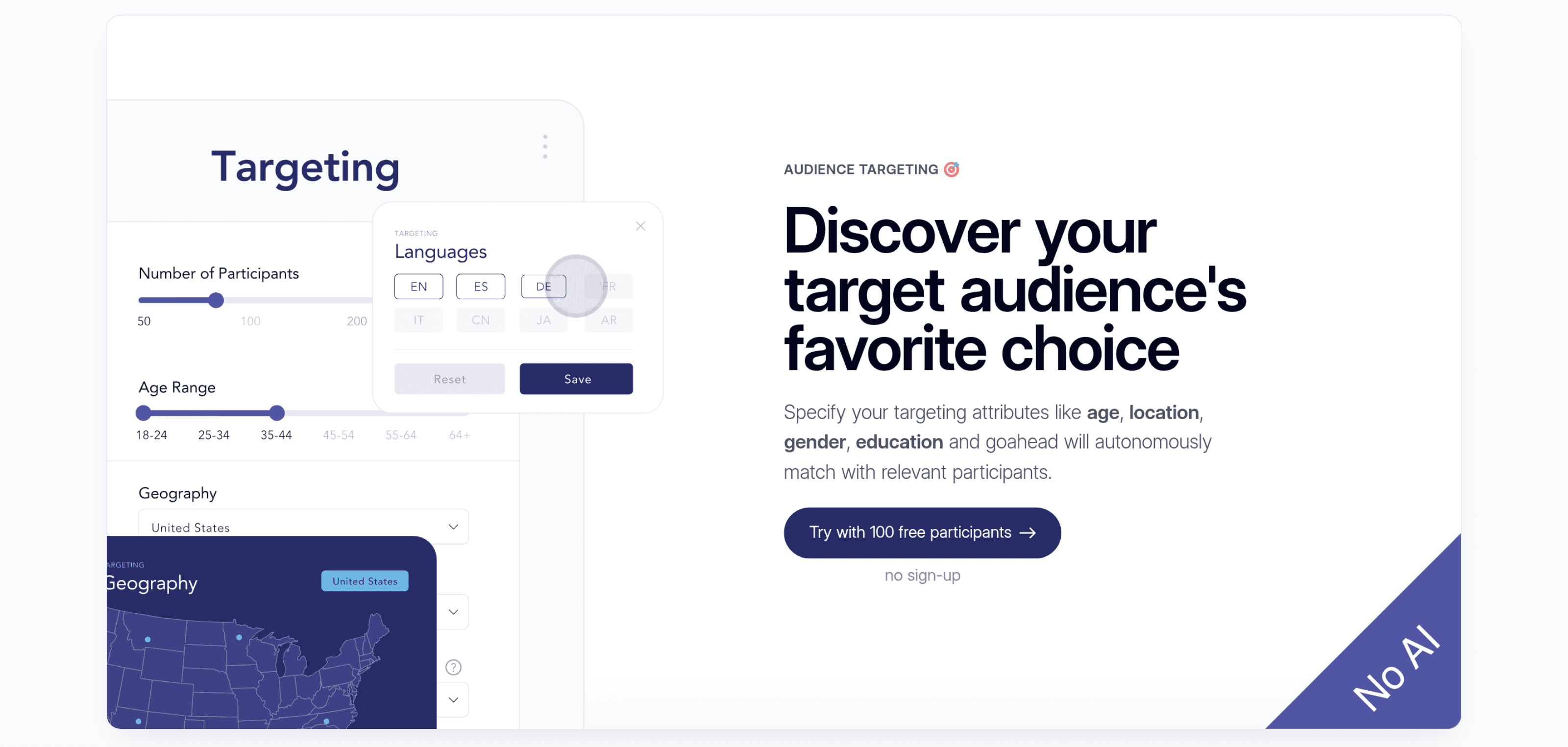
The reason this matters is simple. A packaging test answered by 50 designers tells you what designers like. The same test answered by 50 coffee buyers in your actual markets tells you what your customers like. goahead makes that second thing a few clicks instead of a research project. It's also emphatic that these are real people, not synthetic ones — the feature literally wears a "No AI" badge, which in 2026 is a deliberate and welcome stance.
Results that arrive on their own clock
goahead runs a matched panel around the clock, so once a survey is live you don't chase anyone — responses accumulate on their own and the dashboard fills in as they land. The live view shows a completion ring, a running count of participant answers against your target (ticking up with a "+23 answers in the last 24 hours" note), and an elapsed-time clock against the runtime window you set.
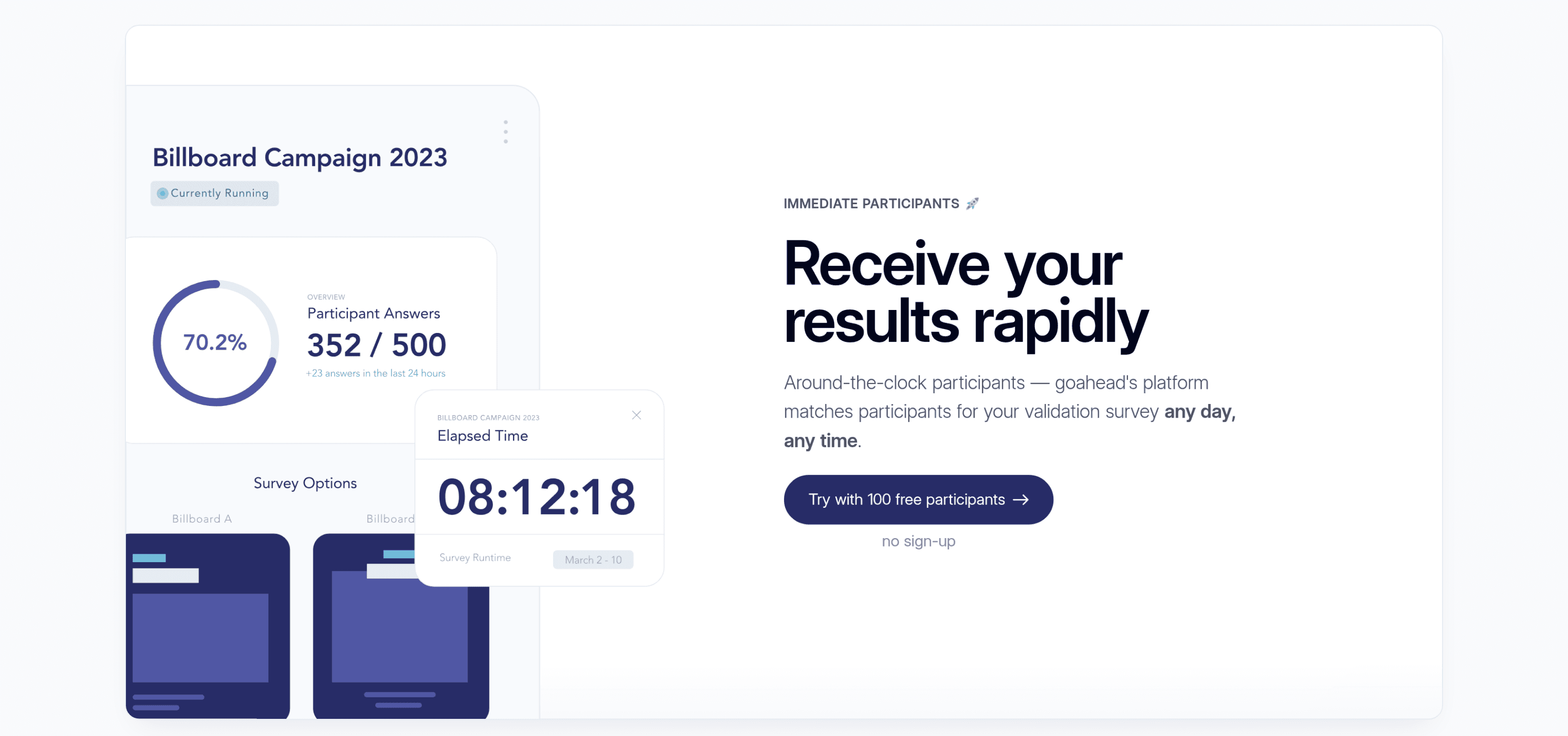
I'll be honest about the word "immediate," though: this is fast matching, not instant results. A survey has a runtime — I saw options up to a full day, and the sample surveys on the site ran anywhere from 8 to 24 hours — because it genuinely takes time for enough real humans to respond. That's the price of a result you can trust, and it's the honest tradeoff to make.
Qualitative feedback: the "why" behind the winner
A preference test tells you which design won. It doesn't tell you why. goahead lets you bolt up to five follow-up questions onto any survey to close that gap. Toggle it on and you can add a question with a response type: Short Text, Yes Or No, Rating, or Opinion Scale. I added a short-text question — "What is your overall impression of the winning design?" — and those written answers come back as individual response cards, complete with star ratings, so you can read the reasoning in the participants' own words rather than inferring it.
That combination — a hard, quantitative winner plus a stack of qualitative comments — is what makes the output usable in a room full of stakeholders. You get the number and the story.
Reporting and sharing
Once results are in, goahead turns them into reports you can hand upward. Every survey card carries a Send report and Export PDF action, and the plans layer in summary reports and, higher up, white-label reports — the kind of thing an agency wants when the deliverable has to carry a client's branding rather than goahead's. The report itself is more than a bar chart: alongside the per-variant preference breakdown it shows the significance level as a badge and even plots a z-score distribution curve, so the rigor is visible, not just asserted.

There's also a sharing side that's easy to overlook. Beyond the anonymous matched panel, you can send the same survey privately to specific people — colleagues, mentors, clients — by email, and examine their individual answers separately from the crowd. A public-sharing toggle (with an optional "force verification" setting) lets you open the survey up more widely when you want reach. So goahead covers both "what does the market think" and "what do the specific people I trust think," which are genuinely different questions.
What is statistical significance in marketing, and why goahead leans on it
Here's the concept the whole product is built around, and it's worth spelling out because it's the thing most creative testing quietly skips.
Statistical significance in marketing is the claim that a difference you measured — variant B beat variant A — is a real preference in your audience, not a fluke of who happened to answer. Ask three coworkers and a 2-to-1 split means almost nothing; swap one person and it flips. Ask a large enough, well-targeted group and a clear split is very likely to hold true for the wider population you care about. Researchers conventionally treat a result as significant at a 95% threshold — i.e. only a 5% chance the difference came from randomness.
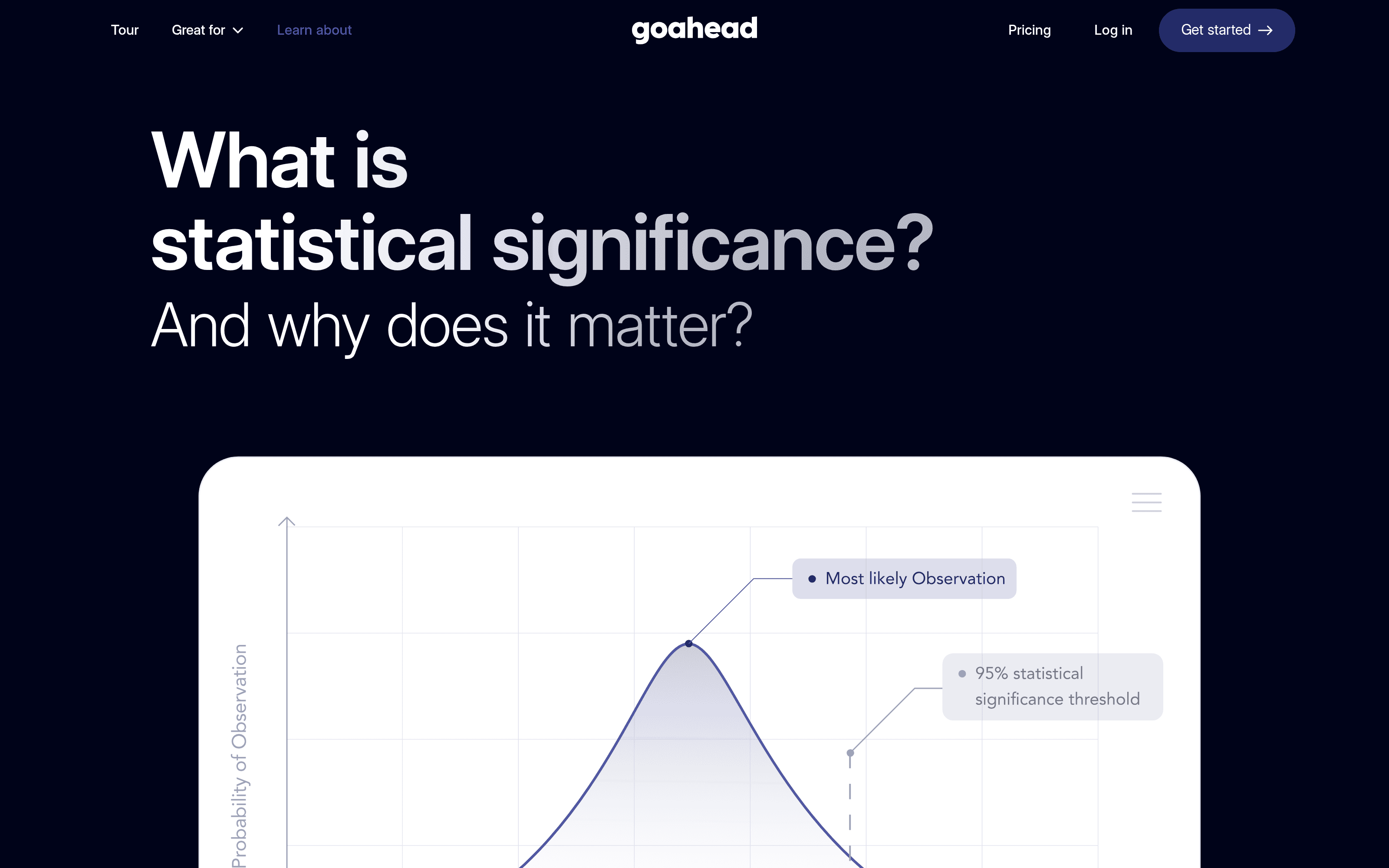
goahead has a whole explainer page on this, walked through with a clean drug-trial example (33 of 200 on placebo got sick versus 11 of 200 on the drug, a gap unlikely by chance), then mapped onto branding: two logos, a large targeted sample, and a test of whether one was genuinely preferred. What I like is that goahead doesn't ask you to do any of the maths. You set the sample and the targeting; it handles the significance and just surfaces the winner. The rigor is the product; the interface is a wizard.
The wider product
A few more things worth knowing, gathered from testing and the plans:
- Use cases across creative fields — the site organises itself around Advertising, Public Relations, Film/Media/TV, Ecommerce & Web, Publishing & News, and Gaming, with content and question templates to match.
- Monadic and forced-choice options — beyond simple preference tests, so you can show each participant one variant in isolation or force a direct pick (this one is Ultimate-tier).
- Branded experience — a custom sub-domain, post-survey redirection, and a branded survey experience on the paid tiers.
- Desktop apps — goahead ships desktop apps alongside the web platform.
- Privacy built in — all submission data respects GDPR and CCPA, surveys can be fully anonymous, discrete, or even self-destructive, and data in transit is encrypted. SSO/SAML and NDA signature show up on the top tier.
Pricing & plans
goahead runs on credits, and this is the part to read carefully. One credit is roughly one completed response to a simple preference survey with broad targeting. The more complex the survey (more variants, follow-up questions) or the more niche the targeting, the more credits each response costs — the builder quotes a range of 1 to 5 credits and updates the total live as you build. My own demo (two variants, one follow-up question, two-country targeting, 50 participants) came out to 100 credits — about two credits per response — which makes the model tangible: it's not a flat per-head price, it scales with how demanding the test is.
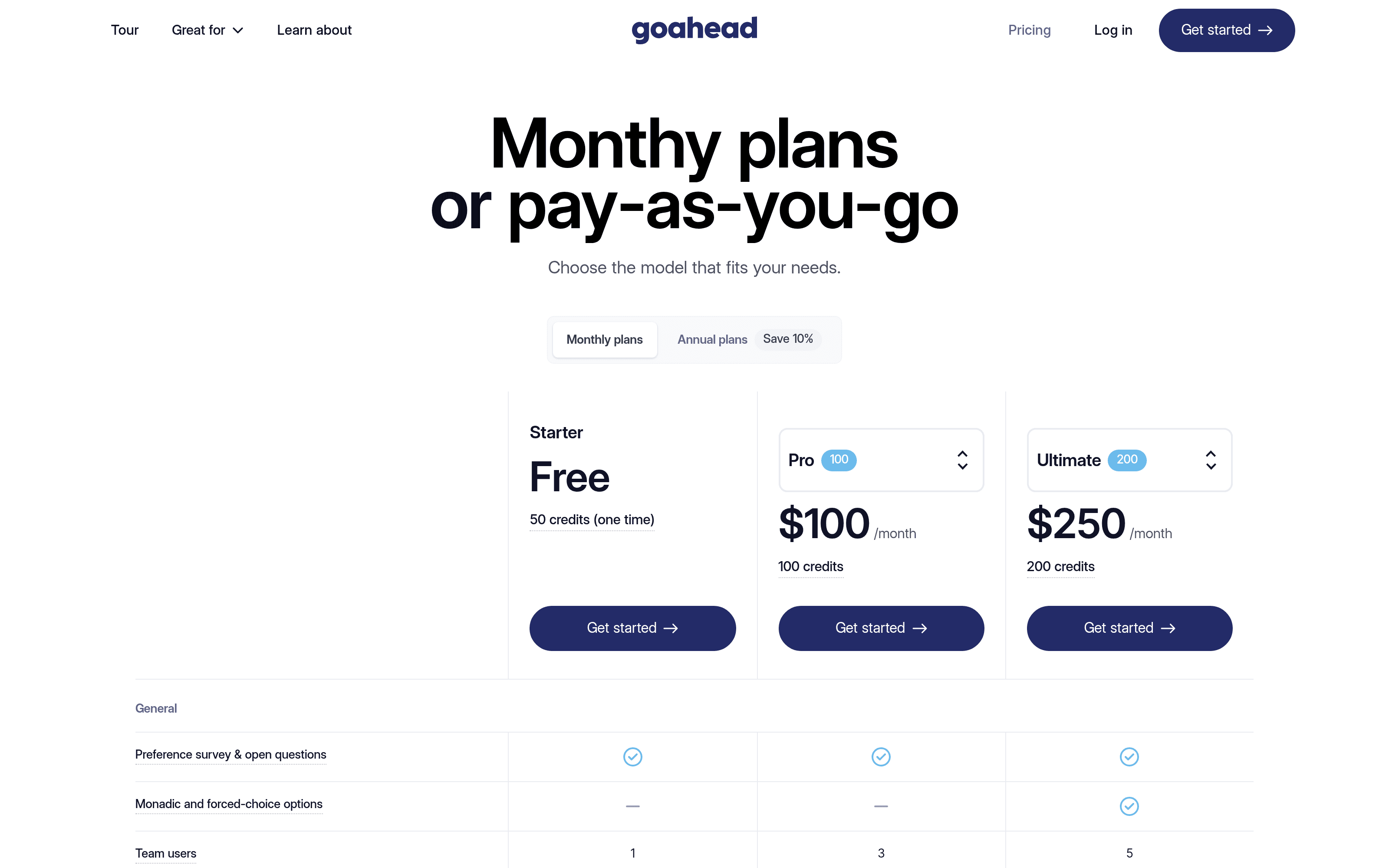
The monthly plans:
- Starter — Free: 50 credits, one time. 1 team user, basic analytics. Enough to run a real first test.
- Pro — $100/mo: 100 credits/month, 3 team users, advanced analytics, summary reports.
- Ultimate — $250/mo: 200 credits/month, 5 team users, enterprise analytics, white-label reports, SSO/SAML, NDA signature.
Annual billing saves 10%. If you don't validate regularly, there's pay-as-you-go: a 100-credit bundle is $125, and bundle credits don't expire — whereas unused monthly-plan credits don't roll over. That's a fair split: subscribe if it's a habit, buy a bundle if it's occasional.
Who should use goahead?
It's a strong fit if you are:
- A designer, brand or marketing team that has to defend a creative choice to a client or an exec and wants real audience data behind it rather than a hunch.
- An agency running validation for clients, who'll get real mileage out of white-label reports and a branded survey experience.
- Anyone launching packaging, ads, covers, or product imagery into a specific market and worried about testing it on the wrong crowd.
It's less essential if you only ever need a quick gut-check from a couple of people, or if your decisions genuinely don't hinge on audience preference. goahead is built for the moment the choice actually matters and you want to be sure — and that rigor costs a bit of time and a few credits.
Conclusion
That's the end of this goahead review. What stayed with me is how it takes something intimidating — statistical significance — and hides all the hard parts behind a six-step wizard, while keeping the honesty of the concept front and centre. You bring clean variants and a clear question; it brings the targeted audience and the maths.
The easiest way to feel it is the free route: run your own A/B on a design you're arguing about right now, with 100 free participants and no signup, and see whether the "obvious" winner actually wins.
What I liked:
- A real validation panel with proper audience targeting (age, location, gender, reach), not just a poll.
- The whole thing is genuinely built on statistical significance, and it hides the maths so you don't have to be a statistician.
- Try it with no account, no card — the six-step builder is open to anyone.
- Qualitative follow-up questions give you the why, not just the winning variant.
- Clean, honest pricing: monthly credits or non-expiring pay-as-you-go bundles.
Things to keep in mind:
- "Immediate" means fast matching, not instant answers — surveys run for hours (up to a day) while real people respond.
- The credit model scales with survey complexity and targeting, so a demanding test costs more per response, and monthly credits don't roll over.
- You have to bring clean, distraction-free variants yourself; garbage in, garbage out.
- SSO/SAML and NDA signature are Ultimate-tier only.
If you're tired of settling creative arguments by seniority instead of evidence, goahead is well worth a run.
Related Articles